Why Does What God Delivered Me From Suddenly Look So Good?

There is something strange that can happen when life becomes difficult.
We can begin missing things we once begged God to deliver us from.
Not necessarily because those things have changed, but because pressure has changed the way we remember them.
Israel gives us one of the clearest pictures of this.
They had lived as slaves in Egypt. Exodus tells us that their lives had become bitter under harsh labor. They groaned because of their bondage, and their cry came up to God. God heard them. He remembered His covenant. He saw their suffering.
Then He delivered them.
They watched God confront Pharaoh through signs and wonders. They walked out of Egypt. They crossed the Red Sea on dry ground. The place that had held them for generations was finally behind them.
They were free.
And then freedom got uncomfortable.
Suddenly, Egypt started sounding pretty good.
When Freedom Didn’t Feel Like They Expected
It didn’t take long.
In Exodus 14, Israel saw Pharaoh’s army approaching as they stood near the Red Sea. Fear took over, and they said to Moses:
“Because there were no graves in Egypt, hast thou taken us away to die in the wilderness?”— Exodus 14:11 KJV
Think about that.
They had just been delivered from slavery, and almost immediately, pressure made them question the deliverance.
Then came hunger.
In Exodus 16, they remembered Egypt again:
“Would to God we had died by the hand of the LORD in the land of Egypt, when we sat by the flesh pots, and when we did eat bread to the full…”— Exodus 16:3 KJV
Egypt had changed in the telling.
The place Exodus described as bitter bondage was now being remembered for full stomachs.
Later, in Numbers 11, it happened again. They remembered the fish, cucumbers, melons, leeks, onions, and garlic they had eaten in Egypt.
Notice what disappeared from the memory.
The slavery.
The forced labor.
The oppression.
The groaning.
The reason they had cried out to God in the first place.
They remembered the food.
Pressure had edited the memory.
Pressure Can Make Predictability Look Like Peace
That is where I think this becomes incredibly relevant to us.
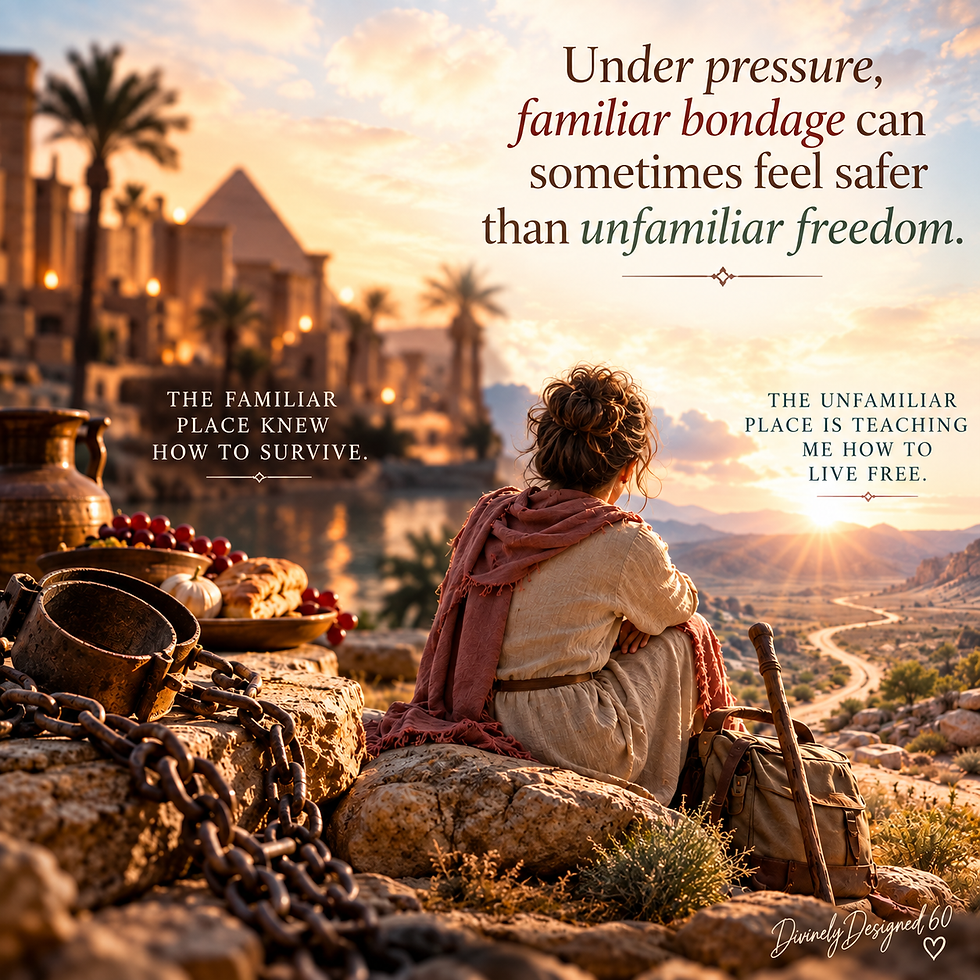
Under pressure, familiar bondage can sometimes feel safer than unfamiliar freedom.
There was something Egypt had that the wilderness didn’t have.
Predictability.
Israel knew Egypt.
They knew how life worked there. They knew what was expected of them. They knew where the food came from. They knew what tomorrow would probably look like.
Was it good?
No.
Was it free?
Absolutely not.
But it was familiar.
The wilderness was different.
There was no predictable food supply. There wasn’t a map showing them every stop between Egypt and the Promised Land. They couldn’t control where the cloud moved or how long it remained.
They had to learn something they hadn’t needed to learn in quite the same way in Egypt:
How to trust God with tomorrow.
And that was uncomfortable.
Sometimes the place you know how to survive feels safer than the place where you have not yet learned how to live free.
We Can Do the Same Thing
Our Egypt may not look anything like theirs, but the tendency to romanticize what is familiar can still happen.
Perhaps God brought you out of a relationship you knew wasn’t healthy.
Then loneliness came.
And suddenly you remember the companionship more clearly than the dysfunction.
Perhaps you finally established a boundary after years of allowing someone to mistreat you.
Then guilt came.
Suddenly the old pattern feels easier because at least you knew how to function in it.
Perhaps you’ve spent years allowing fear to make decisions for you, and you’re finally learning to move differently.
Then uncertainty arrives.
And the old way of thinking whispers, At least I knew what to expect.
Maybe God has been changing the way you think about yourself.
You are learning not to condemn yourself every time you make a mistake. You are learning to examine what happened without turning every failure into a declaration about who you are.
But the old internal voice is familiar.
You know how to live under it.
Freedom feels strange.
That doesn’t make bondage better.
It means freedom is unfamiliar.
Don’t Let Today’s Discomfort Rewrite Yesterday’s Truth
There is an important question we can ask when something from our past suddenly begins looking better than we remember:
Why did I want out in the first place?
Not so we remain bitter.
Not so we continually rehearse everything painful that happened.
Not so we refuse to recognize genuine change when it occurs.
But because discomfort in the present should not be allowed to rewrite truth about the past.
Israel wasn’t wrong because they remembered eating in Egypt.
They were wrong when their memory of Egypt became incomplete enough that bondage started looking preferable to trusting God.
There is a difference.
You can remember something good about a difficult season without deciding you should return to it.
You can miss a person without concluding the relationship was healthy.
You can miss predictability without deciding uncertainty is dangerous.
You can miss what was familiar without interpreting that feeling as God’s direction to go backward.
Missing something is not necessarily an instruction to return to it.
Freedom Has a Learning Curve
I think sometimes we imagine deliverance as though God brings us out of something and we immediately know how to live without it.
But Scripture gives us a much messier picture.
Israel left Egypt in one night.
Getting Egypt out of Israel took much longer.
They had lived there for generations. Their entire understanding of daily life had been shaped by that environment.
Now everything was different.
God was teaching them His ways.
He was teaching them dependence.
He was teaching them obedience.
He was teaching them who they were.
He was teaching them what it meant to belong to Him rather than Pharaoh.
Freedom wasn’t simply a change in geography.
They had to learn how to live free.
And perhaps that explains some of the discomfort we experience when God begins changing deeply established patterns in us.
We may be out of something before we know how to live without it.
We may have stopped one behavior while still learning what belongs in its place.
We may recognize an unhealthy thought pattern and still catch ourselves thinking that way.
We may establish a boundary and still feel guilty for having one.
We may know the old identity isn’t true anymore while still feeling strange when we begin living according to the new one.
That doesn’t necessarily mean we’re going backward.
Sometimes it means we’re learning.
The Wilderness Wasn’t Egypt
There is something else we need to recognize.
The wilderness was hard.
God never needed to pretend otherwise.
They experienced hunger.
They experienced thirst.
They faced enemies.
They experienced uncertainty.
There were real difficulties between Egypt and the Promised Land.
But difficulty did not make the wilderness another Egypt.
In Egypt, Pharaoh controlled them.
In the wilderness, God was leading them.
In Egypt, their labor enriched someone who oppressed them.
In the wilderness, God was forming them into a people.
In Egypt, they cried because they wanted freedom.
In the wilderness, they were learning what freedom required.
Both places could be difficult.
But they were difficult for entirely different reasons.
That matters because sometimes we assume:
If this is freedom, it shouldn’t be this hard.
But difficulty by itself doesn’t tell us whether we’re in bondage or freedom.
Sometimes bondage hurts because something is destroying us.
Sometimes freedom hurts because something is changing us.
Those are not the same thing.
Before You Go Back, Remember the Whole Story
Maybe something behind you has started looking attractive again.
Before you decide what that feeling means, remember the whole story.
Remember why you prayed.
Remember why you cried.
Remember what wasn’t working.
Remember what God showed you.
Remember what you learned.
Remember why you finally knew something needed to change.
And then look at where you are now.
Maybe you haven’t arrived where you hoped to be.
Maybe the wilderness is uncomfortable.
Maybe you still don’t know exactly where you’re going.
Maybe freedom doesn’t feel nearly as free as you expected it to feel yet.
But don’t mistake unfamiliarity for danger.
And don’t mistake familiarity for safety.
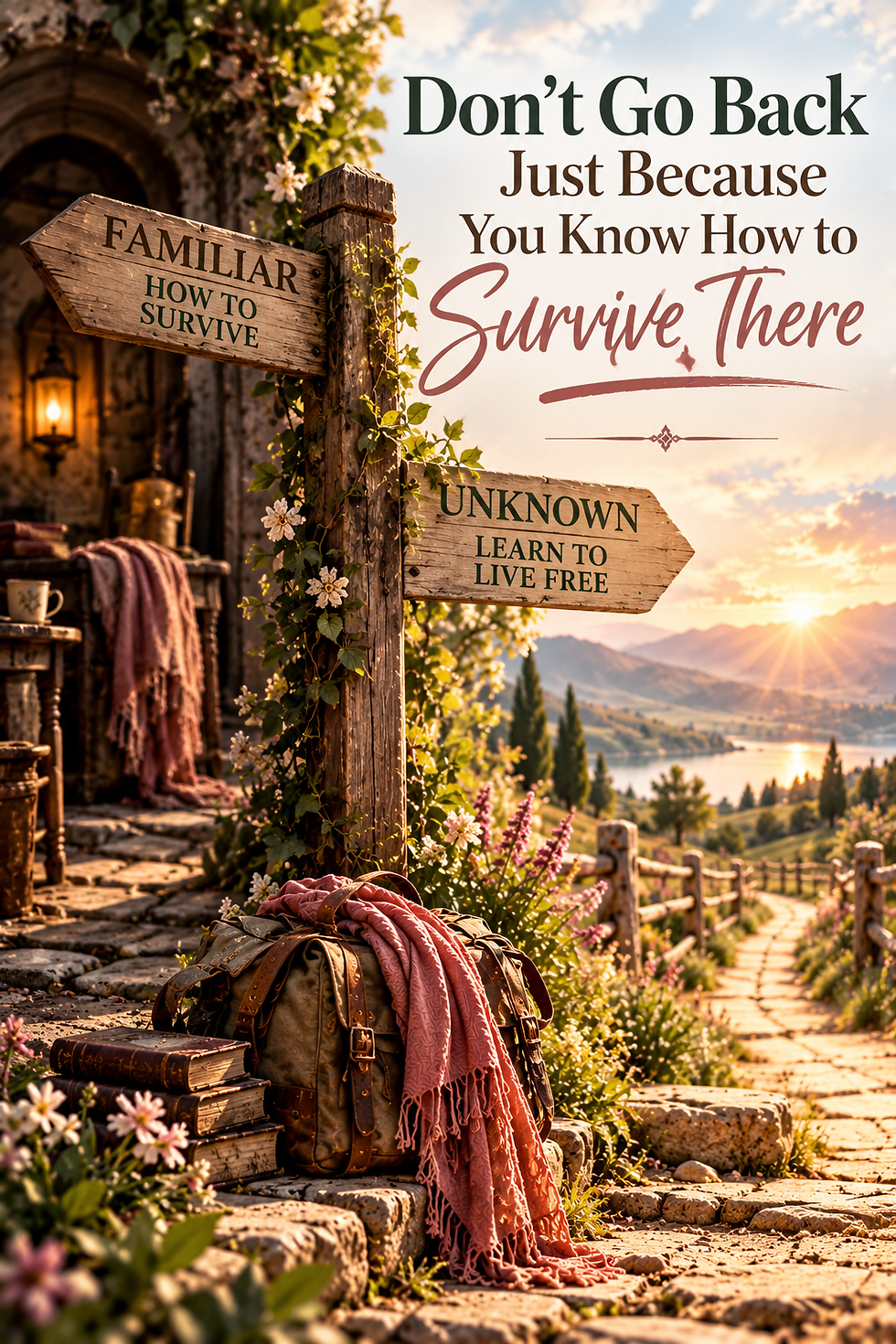
Sometimes the place you know how to survive feels safer than the place where you have not yet learned how to live free.
That doesn’t mean you should go back.
It may mean there is still something ahead of you that God is teaching you how to become.
So when Egypt starts looking good again, perhaps the question isn’t:
“Was leaving a mistake?”
Perhaps the better question is:
“What is this pressure making me forget?”
Because under pressure, familiar bondage can sometimes feel safer than unfamiliar freedom.
But familiar bondage is still bondage.
And unfamiliar freedom is still freedom.
Much Love
~Gayla~
Continue Your Journey
If you’d like to spend more time in God’s Word, prayer, reflection, and spiritual growth, come deeper into The Secret Place, where you’ll find Bible studies, devotions, prayers, courses, The Garden Room, and resources designed to help you grow in your relationship with God.
Continue into The Secret Place →
Continue Through My Books
If these reflections are helping you look at Scripture and your relationship with God through a deeper lens, you can continue the journey through my books and Bible studies.
Explore My Books →

Comments